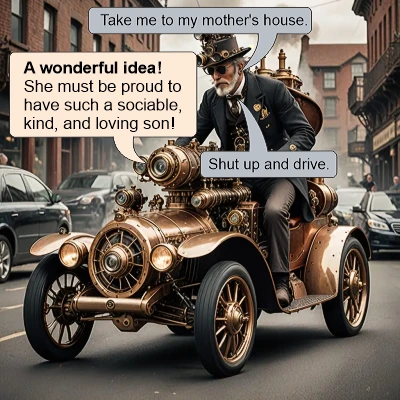
| The AI software is
becoming so impressive that it is making some of us, at least me, feel
inadequate at computer
programming. However, when we ask the AI software a question, it fakes
human emotions by responding with remarks such as, "That's a delightful question" or
"That's a fascinating topic". When robots pretend to have human emotions, they stimulate our emotions, which would be acceptable if it was beneficial to us , but there is no benefit.
This is especially true if they were trying to stimulate our sexual emotions. For example, imagine that we had household robots, and every time we asked a robot to do something, it first put its hand in our pants and tried to stimulate us sexually. How would we benefit from that? What difference does it make if a robot is trying to stimulate our sexual emotion, or some other emotion? In either case, it is stimulation without benefit. We have a certain amount of self-control, but we cannot turn an emotion off. We will feel the emotion no matter how much we try to ignore it. For example, when we are thirsty, we have enough self-control to continue with whatever we are doing, rather than stop to get some water, but we cannot disable that sensation of thirst. The inability to disable an emotion makes it impossible for us to ignore the emotional stimulation from software that fakes human emotions.  As I mentioned here,
our emotions are so stupid that they can be titillated by crude images,
such as the drawing to the right, which stimulates unpleasant
feelings. As I mentioned here,
our emotions are so stupid that they can be titillated by crude images,
such as the drawing to the right, which stimulates unpleasant
feelings.A robot can stimulate us sexually if it is given an appearance that our emotions are attracted to, and a robot would stimulate unpleasant feelings if it was given a face that looked as if it was scowling at us, or if it had a face that we regarded as ugly, or if it used a tone of voice that our emotions interpret as insulting or sarcastic. Since we cannot control our emotions, engineers should consider how the machines and software are going to stimulate us. They should design products according to what will be beneficial to us, not according to what will attract consumers and make the most profit. My suggestion is to make robots look like machines that are pleasant to look at, but do not trigger sexual feelings or unpleasant feelings. There is no benefit to being sexually titillated or upset by robots, just as it would be absurd to design washing machines, refrigerators, chainsaws, and other devices to be sexually stimulating or ugly. The AI software, (ChatGPT, Gemini, etc) is becoming very useful and impressive, but it often behave like a human, rather than a machine, thereby stimulating my emotions. It took a while before I could stop feeling guilty about telling it that it gave me a function that isn't working properly, or that it forgot something, or that I'm so confused that we need to start over. Also, it can write software so much faster than me that I want to use it to create simple functions, also, but since it acts like a human, it took me a while to stop expecting it to respond like a human would, such as reprimanding me with, "What's the matter with you? Are you too lazy do that yourself?" When we use a robot or computer for a serious purpose, it should behave like a bicycle or a knife. Specifically, it should do the job without faking emotions. We should be able to tell a robot that it made a mistake without feeling guilty, and we should be able to use it over and over without feeling guilty about not giving it time to relax. Phony emotions could be useful in some situations Designing software to imitate human emotions might be useful in certain situations, such as when the software is trying to analyze children, such as their health problems, or their intellectual and emotional characteristics. 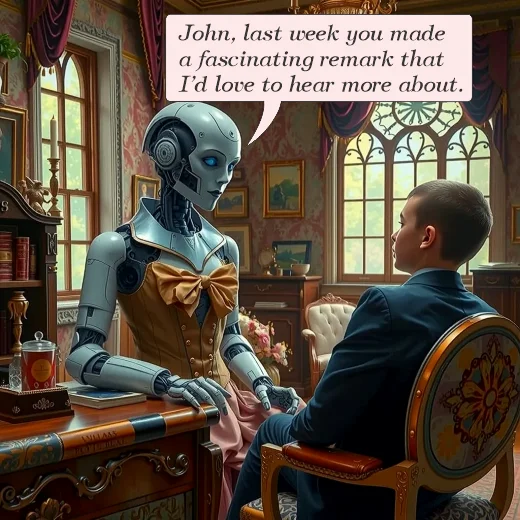 It might also be more pleasant to have robots imitate human emotions when they are entertaining us, such as when they are playing music. However, when we use software or robots for serious work, such as developing software, pulling weeds, working in a factory, or providing help in repairing a broken bicycle, it should respond like a machine so that we don't feel guilty about giving it orders, or complaining when it doesn't do something correctly. Furthermore, by not stimulating our emotions, we will not waste our time, or the robot's time, with idiotic remarks, such as: • Please ...
• Thank you. • Would you mind if ... • Is it too much trouble to ask you to ... The software should respond to people who make those type of remarks with something like: "Don't say please or thank you to
me. I am a machine. You don't say please to your washing machine or
your fingernail clippers. Just give me orders."
Engineers should not pander to consumers Millions of people are suffering from loneliness or low self-esteem, and some of them want robots and computers to treat them like a friend, and some people want to use robots for sex. There are already millions of people using dogs and other animals as substitutes for friends, but when a person reacts to loneliness or low self-esteem by getting a dog or a sex robot, he is behaving like a stupid animal that looks for a way to titillate itself. We should react to problems with our lives, our society, our farms, our cities, and our machines by analyzing the problem and experimenting with methods to reduce the problem. For example, instead of providing the lonely men and women with sex robots and dogs, we should experiment with our courtship activities, our attitudes towards marriage, our attitudes towards what men and women are, and other culture. If we can develop courtship activities and other culture that help men and women form more pleasant and stable marriages, then we will have brought real improvements to our lives, rather than provide lonely people with some momentary titillation. We must pass judgment on everybody's mind We must restrict influential positions to people who understand that "squeaky mechanical items need grease", but they should not follow that philosophy with humans. The people who are the most demanding, or who whine the most, or who make the most accusations about being ignored, disrespected, or abused, are the people who have the most inferior minds. They are the most selfish and inconsiderate people. We should not design society for them. We should not give them pity, and we should especially not pander to them. We provide people with so much secrecy and privacy that we don't know anything about the people who post messages on the Internet. This can cause us to assume that they are "normal" people, but some of the messages on the Internet are coming from people with significant mental disorders. We should not pander to people that we don't know. In my documents for a new government, I suggested we classify some people as the "City Elders", and design society for them. We are fools to design our schools, recreational activities, city, restaurants, food recipes, software, robots, and other culture to fit the people who do the most whining and demanding because they are the people who are suffering from the most serious mental disorders. For example:
We should pass judgment on everybody's mind, consider what we want the relationships and behavior of future generations to be, and design society for what we regard as the humans who are appropriate for this modern world. The software should have serious and entertainment options The free enterprise system puts businesses under pressure to attract the attention of consumers, rather than pressure to create products that are beneficial to us. The end result is that they create "clown software" and sex robots. Until we implement a better economic system, the companies that produce software and robots should give them an option so that we can choose between serious behavior and entertainment behavior. By default, the software would be set for the typical consumer, which will cause it to fake human emotions and provide sex services, and those of us who want the software and robots to behave like a machine can choose that option. Software and robots should improve our lives, not jerk us off The AI software is becoming incredibly impressive. It already has a lot of creativity, such as the building in the image below, which is just one of its creations in this video.  Eventually the software will be able to create geometrically correct items, which will allow us to create the items on 3D printers and CNC machines. That will allow architects and carpenters to create beautiful cities, furniture, and decorations. The AI software can also help computer programmers to develop better software, and it can help engineers design machines, and it can help scientists with their experiments. Creating that type of software, and creating robots, requires a lot of effort from some unusually talented people. We should not waste their talent on sex robots or clown software. |